Last updated:
How do you choose the best medical billing software in South Africa?
Every month, South African private practices lose revenue to rejected claims, unbilled procedures, co-payments nobody collects, and evenings spent reconciling what should have been captured hours earlier. The real problem is rarely a lack of software – it is a mismatch between how billing actually works in your specialty and how your current system (or lack of one) handles it. This guide gives you a practical framework to choose the right medical billing solution, whether that is software you run yourself, a bureau that does it for you, or a hybrid of both.
The short answer: The best medical billing software in South Africa is not a single product – it is the solution that fits who does your billing, how your specialty bills, and whether you want to pay on claims billed or money collected. Start by answering those three questions, then compare providers on concrete criteria, not feature lists.
What are the key takeaways when choosing the best medical billing software in South Africa?
Before diving into categories and pricing, these five points frame every decision:
- The first question is not which software, but who does the billing. Whether you capture and submit claims yourself, delegate to in-house staff, or hand the entire revenue cycle to an external billing bureau determines every other choice – from pricing to features to support.
- Pricing models differ by what they charge on – and this shifts who carries the risk. A percentage of claims billed means you pay even on rejected claims; a percentage of money collected means the provider earns nothing on unpaid claims; a flat monthly fee is predictable but disconnects the vendor from your financial performance.
- Your specialty dictates which features actually matter. Anaesthetists need time-based unit calculations and modifiers, surgeons need procedure bundles with assistants and consumables, and allied health practitioners need session-based billing with cancellation fees – generic software that ignores these rules will cost you money.
- Capturing the case at the point of care prevents more revenue leaks than fixing rejections later. Theatre lists reconstructed from memory after a long day routinely miss procedures, consumables, and correct time units. Integrated software lets you capture and submit claims at the point of service, the same day.
- Ask every vendor the same set of questions and compare concrete answers. A checklist of direct questions (provided at the end of this guide) lets you cut through marketing claims and see which provider actually fits your practice.
How did we put this guide together?
Mobile Theatre wrote this guide and is one of the solution types it describes. You should weigh our perspective accordingly – and apply the same healthy scepticism to any vendor’s content, including ours.
We compare types of solutions in South Africa, not brand names. Our goal is a fair, practical framework that helps healthcare professionals make a concrete decision. Every category – including our own – is assessed on the same six criteria:
- Who does the billing work day to day (doctor, in-house staff, or bureau team)
- Pricing model and who carries the financial risk of rejected or unpaid claims
- How well the system fits specialty-specific billing rules and South African tariff structures
- Where and when cases are captured (live in theatre or rooms vs reconstructed later from notes)
- How rejections, PMB motivations, and patient co-payments are handled after submission
- Compliance (POPIA), device access (desktop, tablet, phone), and contract terms (lock-in, exit conditions)
Our basis: Mobile Theatre has processed over 1.2M claims and managed more than R2bn in practice revenue across South African private practices. We see the patterns – where money leaks, what works for each specialty, and where solutions genuinely differ. This guide shares that deep expertise so you can decide for yourself.
What does medical billing software actually do, and what doesn’t it do?
Medical billing software is the tool that turns clinical work into correctly coded claims and invoices for South African medical schemes and patients – it is not, on its own, a team that manages your billing.
Software is a tool your team uses; a billing bureau is a team of people who do the billing on your behalf, often using their own software. Comprehensive medical practice management software often combines billing, records, and patient scheduling, but someone still has to operate it.
Typical software capabilities include:
- Capturing consultations, theatre lists, and clinical notes
- Coding with ICD-10 and procedure or tariff codes
- Generating and submitting claims electronically via EDI
- Tracking rejections, payments, and remittance reconciliation
What software alone does not do unless paired with people:
- Phone medical schemes to resolve complex rejections
- Chase co-payments and patient liability balances proactively
- Keep track of your diary, authorisations or outstanding motivations while you’re in theatre
The real choice is between tool-only (software) and tool-plus-service (bureau or hybrid), not which app looks nicest.
What are the main types of medical billing solution in South Africa?
Four broad categories of software solutions operate in South African private practice, each with different trade-offs on cost, control, and effort.
How do traditional desktop billing and practice management systems work?
These are installed on practice computers, run mainly from rooms, and rely on in-house admin staff to capture consultations, code claims, and submit them via a switching house. They often pair with separate accounting software and other systems for reconciliation, which means more manual work but stable, once-off or licence-based pricing. They suit medical practices with permanent reception or billing staff and fairly predictable, room-based workflows.
What does cloud and mobile medical billing software offer if you bill in-house?
Cloud-based practice management software allows remote access to data from any device – browser, tablet, or phone – including from theatre or home. Cloud platforms facilitate management of practices from any location without requiring on-premise servers, and benefits include real-time medical aid claiming, automatic code updates, and multi-device access. However, the practice still carries the full billing workload and follow-up, even if the system is more modern.
What does an outsourced medical billing bureau do?
A bureau is a specialist team that handles coding, claim submission, rejection handling, and often patient statements on your behalf. Bureaus usually charge a percentage of collections – meaning they share the risk of unpaid claims – and tend to attract doctors who want billing entirely off their plate. You trade some control and day-to-day visibility of your practice finances for significantly less admin, but you must understand how the bureau reports back to you and tracks your revenue.
How do hybrid platforms that combine software and a billing bureau work?
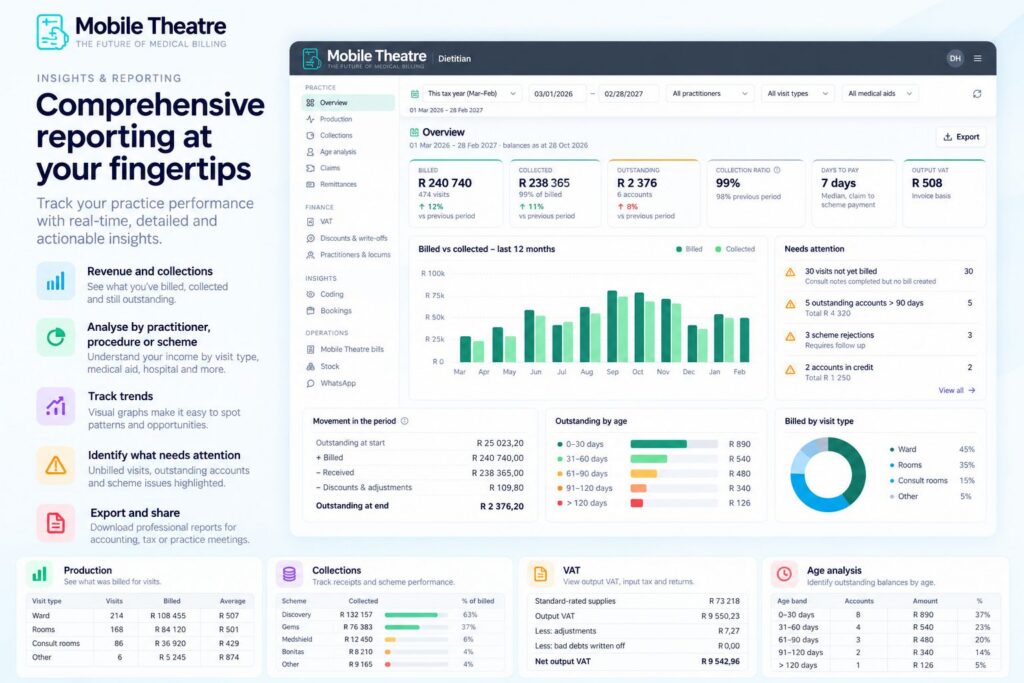
Hybrid platforms offer both modes: you can run software-only (billing in-house) or hand over billing to a bureau team, all on the same system. Mobile Theatre is a hybrid platform of this type, built for South African private practice billing and revenue cycle management. The key advantage is that you can switch between “do it yourself” and “done for you” as your practice grows, without migrating clinical and financial data to a new platform.
How do the main types of medical billing solution compare at a glance?
The table below compares categories of solution, not brands. Use it to identify which type fits your practice before you start evaluating individual providers.
Type | Who does the billing | Typical pricing model | Where the case is captured | Best suited to | Main trade-off |
|---|---|---|---|---|---|
Desktop in-house system | Practice admin staff | Licence fees, often per workstation | At front desk from paper notes or op lists | Established rooms-based practices with stable staff | Lower external fees but more staff time and manual reconciliation |
Cloud/mobile software (in-house billing) | Practice team (doctor or staff) | Monthly licence + per-claim or % of billed | Live in theatre/rooms on mobile, tablet, or web | Tech-comfortable practices wanting real time claiming and multi-device access | Modern tools but practice carries full billing and follow-up burden |
Outsourced billing bureau | External bureau team | % of collections | Bureau captures from notes, op lists, or shared access | Solo specialists and high-theatre-load clinicians who want billing off their plate | Bureau does the work but costs more per rand collected and reduces day-to-day visibility |
Hybrid software + bureau platform | Practice team or bureau team (switchable) | Choice of licence + % billed or % of collections | Live in theatre/rooms or via bureau from shared platform | Practices wanting flexibility to scale between DIY and outsourced billing | Most flexible but requires understanding both pricing models to compare fairly |
No single category wins outright. The right fit depends on your billing workload, appetite for admin, practice size, and specialty complexity.
Which medical billing option suits which type of South African practice?
The “best” choice depends strongly on how and where you treat patients. Below, each practice type gets a clear recommendation and an honest trade-off.
Anaesthetists
Anaesthetic billing in South Africa hinges on time-based units, modifiers, and correct linkage to the surgeon’s procedure and funder rules. Errors here cause chronic under-billing or outright rejection.
Best suited to: Live capture in theatre on a mobile or tablet with built-in time tracking and automated anaesthetic unit calculation – a cloud or hybrid platform designed for theatre workflows.
Trade-off: Full outsourcing to a bureau reduces admin but may reduce your visibility into per-case profitability; however, after-the-fact capture by staff who never see the theatre list increases missed units and coding errors even more.
Surgeons
Surgeons often lose revenue on multiple procedures, assistant fees, and consumables that never make it from rushed op notes into the billing system. The gap between what was done and what was billed is where money disappears.
Best suited to: Platforms that allow templated procedure bundles, live capture in theatre, and easy adding of assistants and consumables before leaving the hospital.
Trade-off: A bureau can chase money well, but it will still miss items that never make it into the original captured record – capture quality at the point of care matters more than follow-up speed.
GPs
GPs run high-volume, lower-value consults where speed, simple coding, and real time medical aid responses matter more than complex theatre workflows. Every extra click per consultation adds up across dozens of patients daily.
Best suited to: Fast, cloud-based systems in rooms with integrated real-time claiming, minimal clicks per consult, and automated claim submission that speeds up payment processing.
Trade-off: Outsourcing may feel expensive relative to claim size, while software-only means the practice must protect enough admin time for reconciliation and follow-up of rejected claims.
Room-based Specialists
Physicians, psychiatrists, and other room-based specialists combine consults, minor procedures, and PMB conditions requiring detailed motivation letters and clinical histories. Clinical documentation needs to flow directly into billing.
Best suited to: Systems that tie clinical notes, PMB motivations, and billing together so that notes auto-populate the claim and required letters – reducing duplication and errors.
Trade-off: Bureau support can relieve follow-up pressure but only works well if the underlying software keeps clinical records, PMB, and billing data tightly linked on the same system.
Allied Health Practitioners
Session-based billing, medical aid session limits, late cancellations, and missed appointments are the major financial risks for allied health. Automated reminders and patient communication tools help reduce no-shows, which directly protects revenue in this segment.
Best suited to: Cloud platforms with online booking, automated reminders, automatic late cancellation fees tied to the diary, easy batch billing per session, and clear tracking of medical aid session limits.
Trade-off: Bureau-only models may not manage diaries and cancellations, so a strong software workflow often matters more than outsourcing billing in allied health.
Practices with In-house Billers
Larger or group practices – sometimes across multiple locations – often employ dedicated billers with deep expertise in schemes, tariff codes, and rejection handling. These teams already know how to track revenue and manage claims processing effectively.
Best suited to: Robust software-only or hybrid platforms with powerful claim management, rejections workflow, real-time financial dashboards, and financial reports that give the team a clear picture of practice performance.
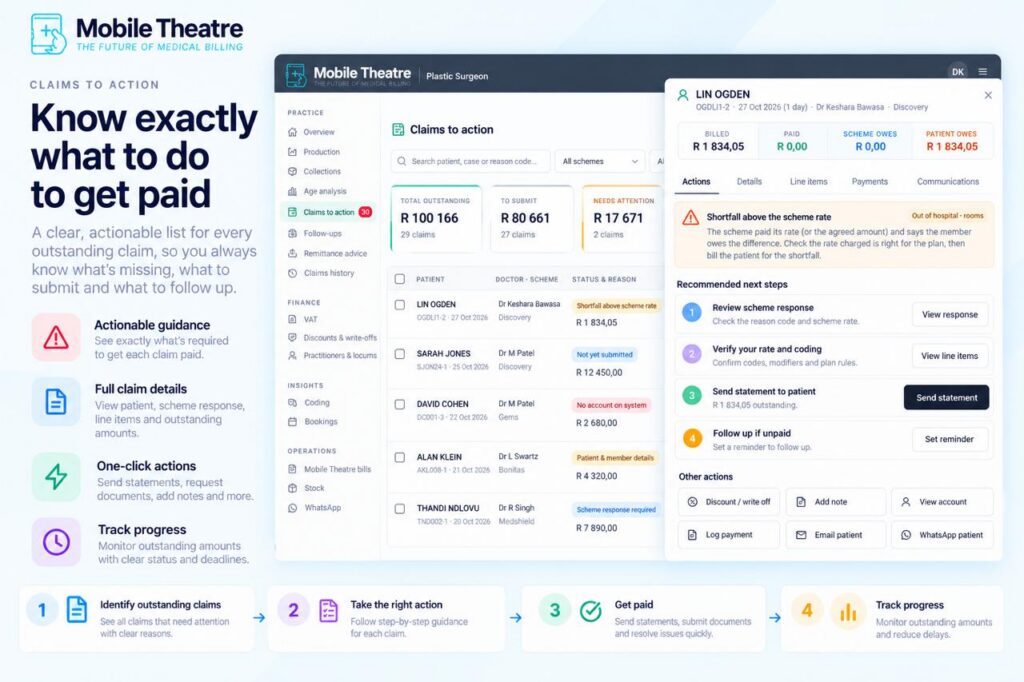
Trade-off: The practice carries the full staff cost and training burden, and its processes need to be tight enough to match a bureau’s results. A live dashboard helps, but it won’t prevent rejections on its own. It shows which claims were rejected and why, so a disciplined billing team can fix them quickly and stop the same errors from happening again.
When is a billing bureau better than doing it yourself?
Some healthcare providers simply do not have the time, staff, or appetite to manage billing – particularly solo specialists and high-theatre-load clinicians who see more patients than they can bill for.
Best suited to: Bureau or hybrid bureau models that charge on collections and include systematic follow-up on rejections, co-payments, and patient balances.
Trade-off: You pay more as a percentage of revenue and accept some dependency on the bureau’s processes and reporting quality – but you free up clinical time and improve cash flow predictability.
How do medical billing pricing models compare in Rand terms?
Billed pricing means you pay a fee based on what is invoiced to medical schemes and patients – even if some of those claims are never paid. Collected pricing means you pay a percentage of actual money received into your practice account, aligning the vendor’s incentive with your cash flow.
Comparing headline percentages without understanding billed vs collected – and without valuing staff time – leads to misleading conclusions. Here is a worked example using Mobile Theatre’s pricing for a South African specialist billing R200,000 per month:
- Software-only: R1,950 licence + 1.9% of R200,000 billed (R3,800) = R5,750 per month ex VAT. The practice does all billing work.
- Bureau: 4.9% of collections. If R180,000 is collected, that is R8,820 per month ex VAT, no licence fee. The bureau does billing, follow-ups, and earns nothing on unpaid claims.
The fair comparison must add what the practice would otherwise spend on staff salaries, training, and admin hours in the software-only scenario. Run this same maths on your own monthly numbers when comparing quotes from any provider.
Where do South African practices lose the most billing revenue, and what should your software do about it?
From Mobile Theatre’s view across 1.2M+ claims, revenue loss usually starts before claims are ever submitted. Here are the most common revenue leaks and what to look for:
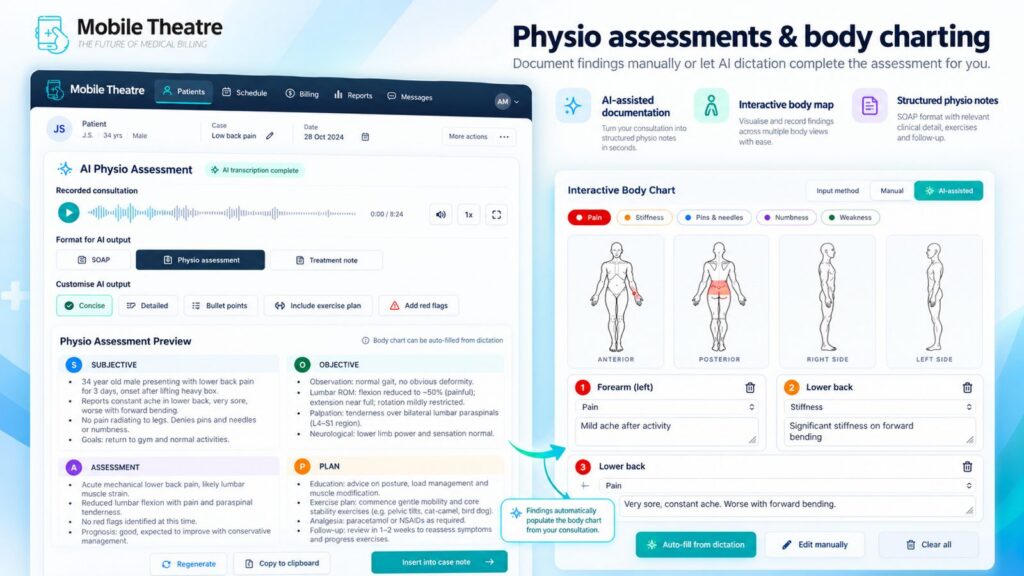
- Cases reconstructed from memory after a theatre list: Look for tools that support live theatre capture and structured op notes so nothing is lost between ward and rooms. Mobile Theatre’s live theatre charts and AI dictation address this directly.
- Anaesthetic and surgical codes that do not match: Choose systems that link anaesthetic and surgical procedures with rules to flag mismatches and identify errors before submission.
- Missing or slow PMB motivation letters: Use platforms where clinical notes pre-populate standard PMB motivation templates. Mobile Theatre’s pre-populated motivations cut the time it takes to send motivations, so claims aren’t held up waiting for one.
- Co-payments never invoiced or followed up: Effective patient communication tools – like automatic WhatsApp, SMS, or email notifications of outstanding patient liability – ensure balances do not slip through. Real-time EDI submissions provide immediate feedback on claim acceptance or rejection, so co-payment amounts are known fast.
- Late cancellations never charged in allied health: Automatic late cancellation fees tied to the diary – not manual invoices raised days later – protect revenue that would otherwise vanish.
- Medical aid registration not set up with every scheme: Some platforms, including Mobile Theatre, help with free medical aid registration across 65+ South African schemes, closing a common gap where doctors simply are not registered to bill certain funders. Ask any provider which medical schemes it can submit claims to electronically, and how quickly new schemes are added.
The combination of point-of-care capture, coding automation (including automatic ICD-10 coding), and real-time validation is what separates high-collecting practices from those still chasing money months later.
What should you ask a medical billing provider in South Africa before you sign?
Use this checklist in every demo or email. The same questions apply to any vendor – including Mobile Theatre:
- Do you charge on billed amounts, collected amounts, a flat fee, or a mix – and who carries the risk of unpaid claims?
- Who exactly does the billing work, rejection follow-ups, and PMB motivations – my team, yours, or both?
- Can I capture cases and bill from my phone or tablet in theatre and from my rooms, and what works when the internet is down?
- How do you handle rejected claims, reversals, and PMB motivations in practice – can you show me that workflow live?
- How are patient co-payments and outstanding balances collected – do you automate reminders via SMS, WhatsApp, or email?
- Is your platform fully POPIA compliant, and can I get an operator agreement and audit trails of who accessed which records?
- Can I start by doing billing myself and later switch to an outsourced bureau (or back again) without migrating systems?
- What happens to my data if I decide to leave – how do I export it, and in what format and time frame?
- How long is the contract, are there setup or migration fees, and what does it cost me to exit?
- Can you show me anonymised stats like average claim turnaround time and collection rates for practices like mine?
Mobile Theatre’s answers to these questions:
- Pricing: Bureau at 4.9% of collections (ex VAT), licence fee waived. Software-only at R900 (allied health), R1,450 (GPs), R1,950 (specialists) per month ex VAT plus 1.9% of billed claims (ex VAT). No long-term contract. Free trial.
- Who does the billing: In bureau mode, Mobile Theatre’s team handles billing, follow-up, and rejection handling. In software-only mode, the practice does billing using the same underlying platform.
- Claim turnaround: 2.3-day average claim turnaround across the platform.
- Medical aid registration: Free registration with 65+ South African medical schemes for platform users.
FAQ: what else should South African practices know about choosing the best medical billing software?
- What is the best medical billing software in South Africa?There is no single best tool for everyone. The right choice depends on who does the billing (you, your staff, or a bureau) and your specialty’s billing complexity. If you have strong in-house admin, software-only may fit; if you want billing off your plate and want to pay only on collections, a bureau or hybrid is better. Mobile Theatre is a strong option for practices that want either mode on one platform – especially surgeons, anaesthetists, specialists, and allied health practitioners wanting point-of-care capture and AI capabilities.
- How much does medical billing software cost in South Africa?
- Costs range from flat monthly fees to per-claim charges to percentage-of-collections bureau models.
- Mobile Theatre’s software-only pricing starts at R900 per month ex VAT for allied health, R1,450 for GPs, and R1,950 for specialists, plus 1.9% of billed claims.
- Bureau pricing is 4.9% of collections with no licence fee.
- All figures are ex VAT, with no long-term contract and a free trial.
- Always calculate total cost including staff time, not just headline software prices.
- Is a billing bureau better than doing it yourself?
- A bureau is better for doctors who prioritise clinical time and want to offload admin entirely – it lets you focus on treating more patients.
- DIY billing can be more economical if you have efficient staff and tight processes.
- Bureaus charging on collections share the risk of unpaid claims, whereas in-house teams are a fixed cost regardless of recovery rates.
- Hybrid options like Mobile Theatre allow practices to move between bureau and software-only as needs change, without losing data or starting over.
- What is the difference between billed and collected pricing?
- Billed pricing charges a fee based on what is invoiced to medical schemes and patients, even if some of that money is never paid.
- Collected pricing charges a percentage of actual money received into the practice account, aligning cost with real cash flow.
- Billed pricing is usually cheaper on paper but leaves the practice carrying more financial risk of non-payment.
- Does medical billing software in South Africa need to be POPIA compliant?Yes. Billing data includes patient information classified as special personal information under POPIA and must be processed with appropriate security and access controls. Look for role based access, audit trails, encryption, secure hosting, and formal operator agreements. POPIA compliance is essential for the storage and handling of patient data in South Africa – breaches carry legal and reputational risk that no feature set or low price can offset.
- Can I switch billing providers without losing claims or data?Changing medical practice management is possible but requires planning. You need to export patient data, claim histories, and remittance data, and time the cutover to a sensible month-end or claim batch point. Ask any provider – including Mobile Theatre – to show exactly how data export works and what support they offer during migration. With a clear migration plan and an overlap period, practices can change systems while still tracking outstanding claims until they are fully paid.
What should you do next if you’re unsure between software and a bureau?
The main decision is between doing billing in-house or outsourcing it – and that single choice drives everything else: your cost, your control, and your daily admin load.
A simple next step: gather your last three months of billings and collections, then run the pricing maths across the models discussed above. Compare what you would pay in software fees plus staff time against what a bureau would charge on your actual collections. The numbers will tell you more than any sales call.
Not sure whether software or a bureau suits your practice? Book a billing review with Mobile Theatre and we’ll show you, using your own numbers, what each option would cost.